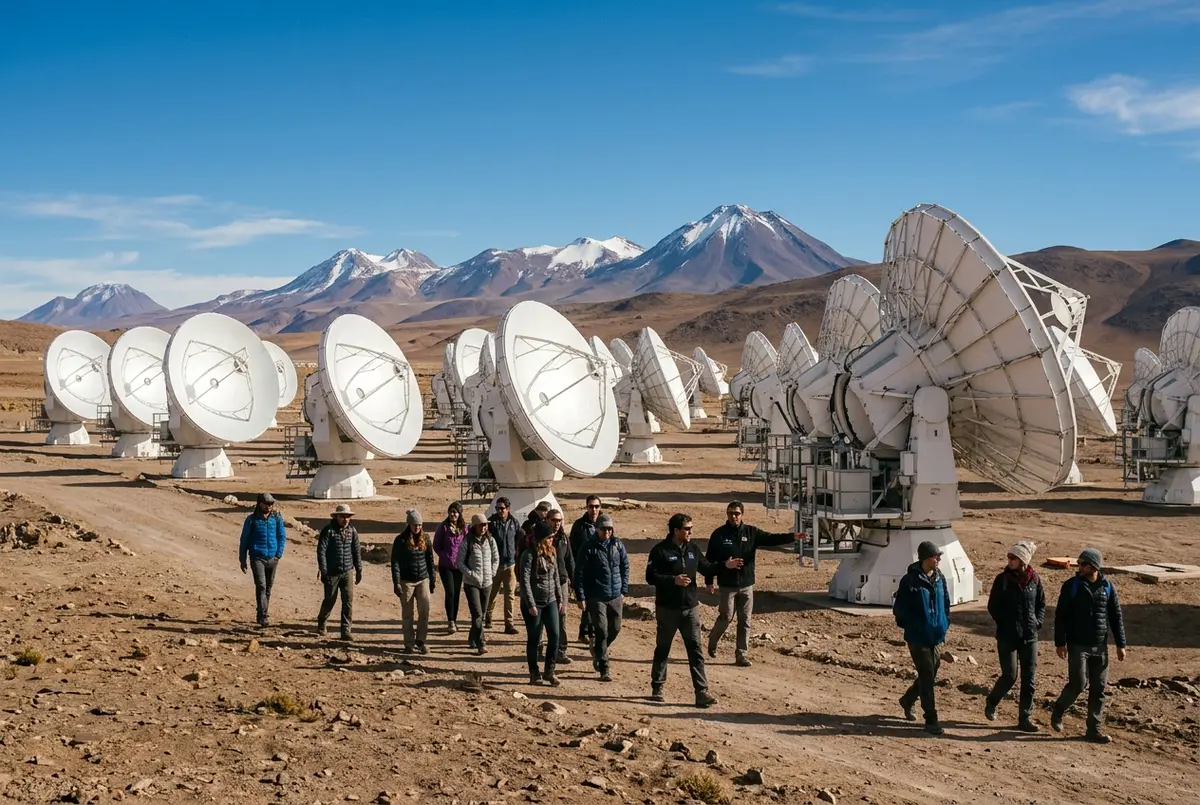
An atacama observatory tour of ALMA means something different from almost every other tour you’ll see listed for San Pedro de Atacama, and I think it’s worth clearing that up before you book anything. ALMA, the Atacama Large Millimeter Array, is a real, working scientific facility on the Chajnantor plateau, not a commercial night sky experience built for visitors.
I’ll explain exactly what ALMA is, how its own limited visiting program actually works, and why most people who search for this are really looking for a different kind of night out entirely. If a dark sky and a telescope in your hands is actually what you’re after, that’s a separate booking, and I’ll point you toward it.
What Is the ALMA Observatory, Exactly?
ALMA is an array of dozens of large radio dish antennas spread across the high Chajnantor plateau, built and operated by an international scientific partnership to study the universe using millimeter and submillimeter wavelengths rather than visible light. It sits far higher and in an even more remote spot than San Pedro de Atacama itself, chosen specifically for the plateau’s extreme dryness and thin atmosphere.
I think the scale of it surprises most people who look into it for the first time. This isn’t a single telescope dome like you might picture from a planetarium visit back home, it’s a coordinated array of separate dishes that work together as one enormous virtual instrument, effectively acting as a telescope far larger than any single dish could ever be built. The partnership behind it spans several countries and research organizations, which is part of why its own visiting rules run through an official process rather than a simple ticket purchase.
Can You Actually Visit ALMA?
Yes, but only through its own limited program, not through a commercial booking you’d find alongside other San Pedro de Atacama excursions. ALMA runs occasional public visit days, typically on weekends, with capped visitor numbers and a reservation process managed directly through the observatory rather than any tour operator or ticketing platform.
My honest advice: if visiting the facility itself genuinely matters to you, check ALMA’s own official visit information well ahead of your trip and plan around whatever dates are open, since this isn’t something you can book spontaneously once you’ve already landed in Chile. For the current program and reservation process, the ALMA Observatory official site is the only reliable source worth trusting.
Why Doesn’t ALMA Run Nightly Stargazing Tours?
Because radio astronomy doesn’t work anything like visual astronomy, and the dishes aren’t pointed at the sky for human eyes to look through in the first place. ALMA detects wavelengths completely invisible to us, which means there’s no eyepiece to peer into and no dramatic telescope image to show a visiting group even if the facility wanted to run tours every night.
I’d say this is the single biggest misconception driving searches for an atacama alma tour. The facility exists to do serious science, not to entertain evening visitors, and its own limited visiting program reflects that priority honestly rather than compromising on it.
What Do You Actually See on an ALMA Visit?
On one of the limited public visit days, you typically see the antenna array from a viewing area, learn about the science from staff or guides on site, and get a sense of the scale and setting rather than hands on access to the instruments themselves. It’s an educational, daytime experience built around understanding the science, not a photography outing or a night under the stars.
My honest take: go in expecting an informative visit to a working research site, not a spectacle. If you’re the kind of traveler who finds genuine satisfaction in seeing how serious science actually gets done, I think this is a worthwhile stop. If you’re mainly chasing a dramatic photo or a night sky experience, it won’t deliver that, and you should look elsewhere.
What If You Actually Want a Night Sky Experience?
This is where most people searching for an atacama telescope tour actually end up, and it’s a completely different, much more accessible booking. A standard guided stargazing tour runs in the evening, uses a portable telescope at a dedicated dark sky viewing site, and is built specifically around giving visitors a hands on look through the eyepiece rather than observing from a distance.
I’d point you straight to my Atacama stargazing tours guide if this is what you’re actually after. It covers the full comparison between a casual telescope session and a dedicated astrophotography outing, and it’s the booking I’d recommend to almost anyone whose goal is simply to see the Milky Way up close. My stargazing tour cost guide also breaks down real prices if budget is part of your decision.
Is There Any Overlap Between the Two Experiences?
Only in spirit, not in logistics. Both ALMA and a commercial stargazing tour exist because this exact stretch of desert offers some of the clearest, driest conditions for observing the universe anywhere on the planet, and both are worth understanding if you care about why this place matters to astronomy at all.
My honest recommendation, if your schedule allows it: visit ALMA during the day if you can get a reservation, then book a stargazing tour on an evening later in your trip, ideally timed around a new moon window using my best time for stargazing guide. Together they give you both sides of the story, the serious science during daylight and the simple, visible wonder of the sky itself after dark. My astrophotography guide is worth a look too if you want to go a step beyond a casual stargazing session on that second booking.
How Far Is ALMA From San Pedro de Atacama?
The array sits a meaningful distance from town, up on the high plateau, and getting there independently isn’t realistic for most visitors without a vehicle suited to the altitude and road conditions. Any approved visit, when the program is open, typically includes transportation arranged through the observatory’s own process rather than a casual drive you’d plan yourself.
I wouldn’t try to improvise a visit without going through the official channel first. Showing up unannounced isn’t going to get you past the gate at a working research facility, regardless of how much you want to see the dishes up close. My Atacama travel guide covers altitude pacing and logistics for the wider trip if you’re still mapping out how a high plateau excursion like this fits around everything else.
Does Altitude Matter for an ALMA Visit?
Yes, significantly more than for a standard evening stargazing tour. The plateau where ALMA sits is considerably higher than San Pedro de Atacama itself, well into altitude ranges that can affect visitors who haven’t acclimatized, which is part of why the observatory’s own visit program manages timing and group logistics carefully.
I’d spend at least a day or two at San Pedro de Atacama’s own altitude before attempting any excursion that climbs significantly higher, ALMA’s plateau included. If you’re also planning El Tatio or the Piedras Rojas circuit, which both climb well above 4,000 meters, I’d sequence your trip so you’re not stacking multiple high altitude days back to back early on.
My Honest Recommendation
If ALMA’s own public visit program has open dates during your trip, I’d try to get a reservation, it’s a genuinely rare chance to see world class radio astronomy up close. For almost everyone else, or as a guaranteed booking you can lock in regardless of ALMA’s schedule, I’d go straight for a standard evening stargazing tour instead, since that’s the experience most people actually picture when they search for an Atacama observatory visit in the first place. You can also browse the full range of Atacama tours on this site if you’re still deciding how this fits into your wider trip.
Frequently Asked Questions
Can I book an ALMA tour the same way I book a stargazing tour?
No. ALMA’s visits run through its own limited, reservation based program, not through the same booking channel as a commercial evening tour.
Do I need to reserve an ALMA visit far in advance?
Yes, reservations are limited and visit days are infrequent, so I’d plan well ahead if visiting the facility itself matters to you.
Is ALMA open at night for visitors?
No, public visits run during the day. The array itself operates around the clock for research, but visitor access isn’t built around nighttime viewing.
What’s the difference between ALMA and a stargazing tour?
ALMA is a daytime visit to a working radio telescope facility. A stargazing tour is an evening excursion where you look through a visual telescope at a dark sky site.
Is visiting ALMA worth it if I just want to see stars?
Not really. If seeing stars and planets through a telescope is your goal, a standard evening stargazing tour delivers that directly, while ALMA is built around a different kind of astronomy entirely.